When Time Pauses on the Battlefield: Arjuna, Fear, and the Promise of Shloka 2.13
An imagined moment on the field of Kurukshetra — not a textbook summary but a breath, a memory, and an inner question that opens the verse: what is truly lost when forms change?
1. The Silence Before the Arrow
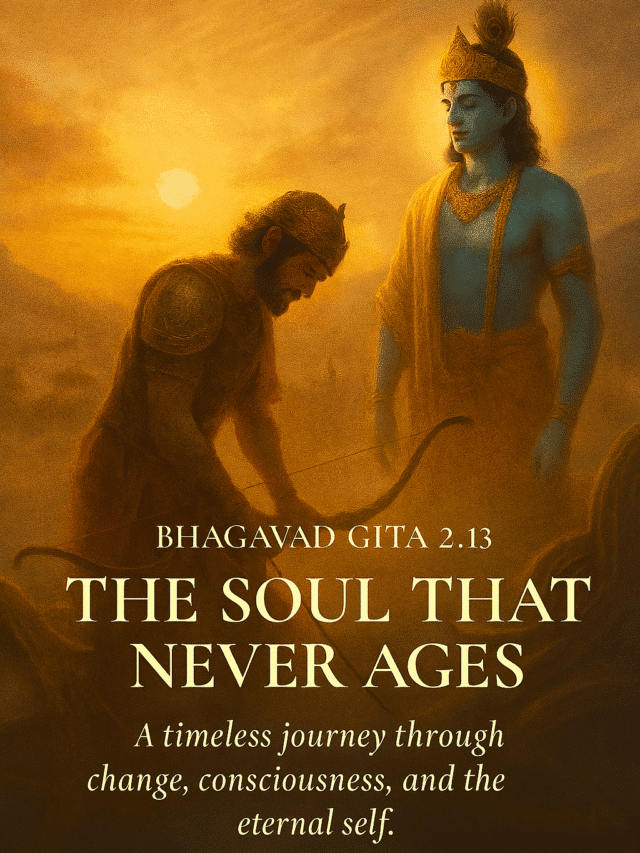
The sky is the colour of bruises. Not because the sun is angry, but because the world seems to be holding its breath. Arjuna’s chariot stands still amid dust and banners; the ranks of warriors wait with their spears lowered, as if the earth itself is listening.The Bhagavad Gita 2.13 meaning comes alive not in theory but in emotion — when Arjuna’s trembling bow mirrors our fear of change.
Imagine Arjuna’s hands — callused from training, steady on the bow until the moment his chest trembles. He looks across the field and sees faces that taught him to speak, to ride, to be. His elders. His teachers. His cousins. Men who once recited the same mantras as him at sunrise, now arrayed as opponents. The bow feels suddenly foreign in his grasp.
2. The Quiet Question — “What if they cease to exist?”
The thought that cuts through him is not tactical. It is unbearably personal: What if the people I love simply cease to exist? It is a voice that belongs to everyone who has watched someone age, to everyone who has turned a photograph and tried to remember the exact shape of a smile.
That question—so immediate, so human—makes his limbs heavy. It reframes the war as a moral puzzle, then as a grief. Arjuna does not argue with his opponents anymore; he argues with the fact of parting, the fact of losing the familiar contours of life. In that moment he is not a prince or a soldier but a son, a friend, a man who loves people too dearly to see them harmed.
3. Fear of Change: Loss, Mortality, and the Small Self
The fear here is not abstract. It is the small, hot foyer beside grief where all of us have sat: the call after midnight, the diagnosis read in flat voices, the silence at the bedside. We call it many names—loss, anxiety, mourning—but at its core is the same sensation that seizes Arjuna: the sense that identity is a fragile collection of relations, of remembered roles, of faces that anchor us.
In modern life the same fear shows up differently: a parent watching a child leave home, a career ending suddenly, a long friendship fraying online. The forms shift; the calendar pages turn. The question we all ask, sometimes aloud and sometimes only in the dark, is whether the thing that loved is still there.
4. Krishna’s Arrival: Calmness that Cuts Through Panic
Into that hush comes Krishna — not loud, not theatrical, but immediate. He steps forward in the middle of doubt like someone who knows that questions are more urgent than commands. There is a clarity in his voice that does not scold; it reorients.
This is the setting for Shloka 2.13. Krishna offers a perspective that will sound odd at first because it runs counter to the panic of the moment: the things that change — bodies, roles, seasons — are not the whole of what you are. His words are not a denial of pain; they are a map drawn in the language of permanence and flow.
(If you want a direct reading of the verse and a line-by-line explanation, see Arjuna and Krishna Conversation — Bhagavad Gita Chapter 2 Explanation.)
5. The Verse in a Moment: What It Promises
When Krishna speaks of childhood, youth, and old age as stages through which the embodied soul passes, he does more than philosophize. He points to continuity — to a witness that watches the seasons of the self. It is not an escape from feeling; it is a way to hold feeling without being swallowed by it.
For Arjuna, that promise is not a consolation trick. It is a practical tool: if the self that loves cannot be extinguished by change, then grief can be met differently. We still feel; we simply no longer have to mistake the form for the entire story.
6. Why This Opening Matters to Us Now
The battlefield is not only a field of spears; it is a scene that reflects the daily battlegrounds of modern life. Whether it is a job lost to automation or a friendship ending without explanation, the fear that the world will rearrange itself beyond our control is universal. Krishna’s voice in Shloka 2.13 invites a different posture: not apathy, but a steadiness that lets us act and grieve with integrity.
If you want to explore how these ideas link to contemporary psychological thinking or to broader Gita teachings, follow this path: The Eternal Soul in Gita — Atman and Body Difference and Self-Realization through the Gita.
The Verse That Redefines Life and Death — Bhagavad Gita 2.13
A careful, human reading of Shloka 2.13: its original Sanskrit, a clear transliteration, a gentle translation, and a way of hearing Krishna’s voice inside everyday loss and change.
1. The Verse — Devanagari and Transliteration
Sanskrit (Devanagari)
नैनं छिन्दन्ति शिवा: श्रयो नापि च्छिद्यते ।
नप्रमेयेन च महात्मना शरीरम् आत्मनः ॥
IAST Transliteration
na enaṁ chindanti śaivaḥ śarīraṁ nāpi chidyate ।
na prameyena ca mahātmāna śarīraṁ ātmanaḥ ॥
Note: different editions sometimes vary in orthography. The lines above capture the common classical reading that appears in most standard commentaries.
2. A Translation That Feels Like a Breath
“The embodied shell is not cut by weapons, nor is it burned by fire; it is not wetted by water, nor dried by wind. Unchangeable, immeasurable, immutable — the Self cannot be harmed. The body is only its temporary home.”
That translation tries to carry two things at once: the doctrinal claim (a continuity of the Self beyond physical change) and the lived consolation (that what we love at its deepest is not annihilated when forms fall away). I choose words like “shell” and “home” precisely because they keep us close to the human scene — someone packing a suitcase, someone lighting a lamp at a bedside — not to distant metaphysical speculation.
3. Krishna’s Tone: Gentle, Clear, Not Dismissive
If you imagine Krishna speaking this to Arjuna, picture this: he doesn’t say “don’t feel” or “you are wrong” — he says, “Hold the feeling; see the shape that feels.” That difference matters. Compassion here is not therapeutic complacency. It is a precise recalibration: grief and duty can coexist, but they will move differently if we understand the ground beneath them.
A modern parallel might help. Think of a parent watching a child leave for the first time. The parent grieves a change in daily routine, in the small habitual presence; but they also sense continuity — the child’s laughter, the stories they told, the values passed on — and those continue, even when proximity ends. Krishna’s voice points to that continuity without diminishing the sting.
4. Emotional Decoding — What This Verse Means for an Ordinary Reader Today
Let’s drop the academic voice. Suppose you are making tea and receive news of an old friend’s death. The room narrows. You taste the kettle’s metal tang like you taste disbelief. In that immediate hour, the doctrine of an “immortal Self” might sound useless. What the verse offers instead is a shift in perspective that helps you hold two truths:
- You feel deeply — your pain is valid, immediate, embodied.
- There is a continuity beyond form — the relationship’s effects, stories, and influences persist.
Practically: the verse gives you permission to grieve and to do the work of life at the same time. It does not prescribe stoic suppression; it reorients grief from a collapse to a process where memory and meaning remain active agents.
For readers who have experienced non-death losses — divorce, career collapse, migration — the same dynamic applies. The “body” that changes can be a job title or a city, and the “Self” that continues is the thread of memory, skill, and character that moves through these external forms.
5. Short Cultural and Literary Touchstones
Across cultures, poets and wise people have used similar images: the Japanese concept of mono no aware (an empathy toward things and the tender sadness of their passing) or Rilke’s instruction to love the questions themselves. The Gita’s language sits alongside these as a practical poem about continuity: it gives courage without flattening complexity.
External commentary that resonates with this tone includes classical translations and modern essays — for background, see the translation at Bhagavad-Gita.org and modern reflections in comparative spirituality.
6. A Close Reading — Line by Line, with Everyday Examples
Let’s unpack two short phrases and then place them in contemporary life:
- “Not cut by weapons” — imagine a reputation attacked online. The “weapon” feels devastating. But the verse invites us to test the difference between the injury to public image and the core of one’s personhood.
- “Unmeasurable, immutable” — think of your earliest memory of your grandmother’s cooking or the first time you learned kindness. Those formative layers remain active; they shape reaction and choice even after the person is gone.
These examples are not metaphors that erase pain; they are invitations to notice continuity inside loss.
7. Practical Takeaways — Small Practices That Echo the Verse
– Anchor memory with ritual: light a lamp or write a short note each week about someone you’ve lost. Ritual sharpens presence, not avoidance.
– Pause before action: when grief or anger spikes, take one breath and name what is changing in form (not identity). Naming softens reactivity.
– Build a continuity box: collect objects, stories, or songs that remind you who you were with them; revisit when the present feels unmoored.
These are small experiments in living what the shloka teaches: honoring form and recognizing what endures.
8. Internal Links and Further Reading
If you want to trace these ideas through the rest of the site, these essays continue the conversation:
- Eternal Soul in Gita — Atman and the Body (internal)
- Atma and Body Difference in Gita — Practical Meanings (internal)
- Karma Yoga in Daily Life — how action and grief weave together (internal)
9. A Brief Scholarly Note (for readers who like sources)
Classical commentators — from Adi Shankaracharya to modern philologists — have translated and debated the metaphoric density of the verse. For readers interested in comparative philology and translation history, consider consulting a bilingual edition (Sanskrit + English) and cross-checking translations. A useful modern commentary can be found at Bhagavad-Gita.org.
10. Closing Reflection — A Small Challenge
The teaching in Shloka 2.13 is not a theory to be memorized; it is a practice to be tested. The challenge I offer you — small, human, and honest — is this:
Over the next week, when something changes (a person, a plan, a mood), name aloud what has shifted in form and what continues underneath. Keep notes. See whether grief loosens its hold or whether it simply becomes clearer.
If you do this experiment, write back in the comments or in your journal. The work of these verses is not to end emotion but to teach precision in feeling — so that we can act from a steadier place.
Childhood, Youth, and Old Age — A Mirror of Transformation (Bhagavad Gita 2.13)
A narrative-led reflection on the Gita’s image of life-stages — with everyday scenes, a psychological lens, and steps to recognize what endures beneath changing roles.
1. Opening Scene: Clay Hands & The Unseen Thread
Begin with a small, sensory moment: a child at a roadside stall, fingers kneading wet clay until a vessel takes shape. The clay’s cool smell, the way a thumb leaves a print — these are details that smell like childhood. Then shift: twenty years later the same hands sign a job contract; thirty years later they cup a cup of tea in the hush of an early morning. The forms change, but there is a single pronoun that witnesses all: “I”.
This is not a metaphysical abstraction. It is an experience you can touch: open a photo album and watch a face rearrange itself through time. The Gita captures that witness in the image of the stages of life — a reminder that change is patterned, not arbitrary.
2. Scene Two: A Parent at the Window — The Slow Vanish of Familiar Rhythms
Tell a short anecdote: a parent watching a teenager leave for college. Describe the small domestic choreography — an empty mug, a worn backpack, the sound of a door. The grief is particular, not universal: it’s the grief of losing a routine, not the person. This nuance is the Gita’s territory.
Ask the reader a gentle question: when did you last notice the difference between losing a habit and losing a person? That question primes the mind to feel the teaching, rather than merely memorise it.
3. Scene Three: The Student and the Old Photograph — Memory as Continuity
Offer a vignette: a student leafs through old photos before an exam — one picture brings a childhood teacher to mind. The memory informs courage. This is an everyday demonstration of continuity: past influences reach forward and shape present action.
Connect this to the Gita’s idea: the Self is not simply a philosophical entity — it is the substrate of memory, skill, and character that threads through life’s episodes.
4. Identity Outside, “I Am” Inside — A Gentle Contrast
Use a conversational tone to compare identity markers (job title, marital status, nationality) with the inner witness: “You may be a teacher, a parent, a migrant — those are roles, not the theater-goer who watches the play.” The Gita does not ask us to abandon roles; it asks us to see the difference.
Offer a short exercise: the next time you name yourself aloud (“I am a…”) pause and notice if there is a quieter “I am” beneath the label. Don’t force an answer — treat it like a small experiment.
5. A Psychological Bridge — Memory, Narrative, and Continuity of Self
Bring in a plain-language psychological insight: modern psychologists talk about the “narrative self” — the story we tell about ourselves, stitched from memory and expectation. The Gita’s witness corresponds with those ideas but places them in a broader ethical and spiritual frame: continuity is not just narrative coherence; it is a living resource for action.
Cite an approachable external source for readers who want to read further, for example a short overview of narrative self theory:
Stanford Encyclopedia — Narrative Self.
6. Real-World Examples That Stay With You
- The craftsperson: hands that once learned a trade continue to remember how muscles move even after retirement.
- The refugee: who loses a home but retains a repertoire of cooking steps, songs and a sense of orientation that survive displacement.
- The once-famous artist: who fades from public view yet keeps an inner standard of taste that continues to shape new work.
Each example illustrates how the “I” functions as continuity: practical memory, habits, and ethical orientation survive changes in outer circumstance.
7. Cultural Resonances — Songs, Proverbs, and Shared Memory
Weaving in a cultural reference helps the reader anchor the idea: quote a short line from a folk song about growing older or a proverb about “seasons of life.” These local touches show that the insight is not foreign doctrine; it is embedded in everyday wisdom.
Example reference: in Hindi folk lore there is a line like “Jeevan ek chabi hai — har mod par naya darwaza” (life as a key opening doors) — use such imagery sparingly and with explanation.
8. Practical Reflection — Micro-practices for Recognizing Continuity
Give concrete, bite-sized practices:
- Photo-threading: pick three photos from different decades and list the single value or habit that links them.
- Three-breath naming: when a role shifts, take three slow breaths and say aloud: “This role changes; I remain.”
- Legacy letter: write one paragraph about what you hope remains of you in ten years — not your job, but the effect you want to have on others.
These are small experiments to test the claim that continuity is discoverable, not just asserted.
9. Internal Links — Continue the Conversation
To explore related themes on this site, follow these essays that deepen the same thread:
10. Closing — A Small Invitation and a Strong Idea
End with a human challenge: during a week of ordinary life, notice one shift in role (a missed appointment, a new task, a changed relationship). When it happens, stop for a moment and write two sentences: one about what changed externally, one about what didn’t. Keep these notes in a single place. After a month, read them back.
Powerful idea to carry forward: the Gita’s model of childhood → youth → old age is not an instruction to detach from life; it is a map for staying present to change while cultivating a steady center — a capacity that makes our choices less reactive and our compassion more durable.
Krishna’s Wisdom Beyond Metaphor – The Science of the Soul
When Krishna speaks of the soul as eternal and the body as transient, he is not asking us to abandon the world — he’s teaching us to understand it. This section explores that insight through Vedanta, modern science, and lived experience.
1. Where Philosophy Meets Breath
There’s a moment in every spiritual journey when words like Atman stop sounding mystical and start feeling intimate. You pause between breaths and realise: the body is breathing, but the “I” that knows it’s breathing — what is that? That’s where Krishna begins his science of the soul.
He doesn’t speak in abstraction. On the battlefield, he talks to Arjuna about something more immediate than philosophy — about identity, fear, and continuity. “As the embodied soul passes through childhood, youth, and old age, so too it passes to another body after death.” The verse, Bhagavad Gita 2.13, is less a sermon and more a revelation about consciousness itself.
2. Vedanta: The Atman as the Unchanging Witness
According to Advaita Vedanta, the Atman — the Self — is the silent witness behind every perception. It watches the mind think, the body age, the world change. It is not affected by these movements, the way the sky isn’t affected by the clouds that drift across it. Shankaracharya described it as “nitya, shuddha, buddha, mukta” — eternal, pure, conscious, free.
This idea can sound lofty until you try it out. When you’re angry, notice how another part of you is aware of that anger. That awareness does not get angry. It’s constant. The Gita calls that awareness the Self — the only part of you that doesn’t come and go.
For a related exploration, see Atman and Consciousness — The Inner Witness and True Knowledge in the Gita.
3. Modern Parallels — Neuroscience and the Puzzle of Consciousness
What happens when philosophy meets science? Neuroscience can now map brain regions linked to memory, attention, and emotion. Yet even scientists admit: there is still no clear answer to how awareness arises. You can record electrical signals in a brain, but not the feeling of being “you.” The mystery remains — who is the witness?
Some modern thinkers call this the “hard problem of consciousness.” The Gita simply points inward: “That which knows, but is not known as an object — that is the Atman.” The Upanishads echo the same. Thousands of years before fMRI scans, Krishna hinted that consciousness is not produced by the brain; it illuminates the brain, just as sunlight reveals objects but is not created by them.
For external perspectives, you might read David Chalmers’ discussions on consciousness or the Stanford Encyclopedia entry on Consciousness — both help trace this ancient question into the modern lab.
4. The Science of the Soul — Beyond Religion
Krishna’s teaching is not about converting anyone; it’s about observation. He invites Arjuna — and us — to experiment with perception itself. What if you spent a day simply watching your thoughts without naming them “mine”? Would you find that the “observer” remains, no matter what thought arises? That’s the experiment of the soul.
This is where Vedanta feels strangely modern. It doesn’t demand belief; it demands attention. It says: test the hypothesis that there is a self beyond the body. Use awareness as your microscope. Use memory as your timeline. You’ll begin to see continuity where you once saw change.
5. What Survives Change?
The question Krishna raises is not metaphysical trivia — it’s personal. When your childhood home no longer exists, when people you loved have vanished, something in you still says “I.” What is that “I”? Not a memory, not an image. Something quieter, older, perhaps unbroken.
Modern psychology calls it “core self-continuity.” Vedanta calls it Atman. Both point to a stable reference point beneath the shifting surface of experiences. Krishna’s genius is to make this a foundation for courage — if nothing truly dies, then grief becomes transformation, not ending.
6. If Nothing Truly Dies — Then What Is Death?
Here, Krishna drops a paradox that still unsettles: “If nothing dies, what then is death?” The answer is not poetic — it’s experiential. Death is the change of form, not the end of being. Just as water turns to vapor yet remains H₂O, the Self moves through conditions while its essence stays untouched.
Death, then, becomes part of a larger economy of renewal. It doesn’t make pain disappear; it reframes it. You can still miss a person, but you no longer imagine they’ve been erased. You imagine them moving — into memory, into influence, into unseen continuity.
7. A Personal Reflection — Science Meets Devotion
I once sat with a physicist friend who confessed he didn’t believe in “souls.” Yet, when his father died, he said something strange: “It felt like he was still here, but in a different bandwidth.” That’s not theology — it’s lived evidence that intuition outruns language.
Krishna’s language is old; its science is timeless. He teaches that energy — consciousness — cannot be destroyed. Whether you express it as physics or faith, the truth lands in the same place: continuity is real.
8. Linking Ancient Insight with Daily Practice
– Observation Practice: Take 10 minutes daily to observe sensations without calling them “mine.” Notice that awareness persists even as they shift.
– Reframing Loss: When you lose something dear, write down what remains — the values, memories, or habits that carry forward.
– Living Vedanta: Before reacting in stress, ask, “Who is aware of this reaction?” That instant of separation is liberation in miniature.
These small experiments embody the science of the soul — a discipline that blends awareness, compassion, and curiosity.
9. Internal Links — Continue Your Reading
10. Closing Reflection — The Soul as Science
The Gita’s language of Atman is not fantasy; it’s an ancient form of phenomenology — a disciplined study of consciousness from the inside. Where modern science looks outward to measure, Krishna turns inward to witness. Both seek truth, but one begins where instruments end: in silence.
The final takeaway: understanding Atman is not about escaping death — it’s about learning to live as something that cannot die. That recognition, once felt, turns fear into freedom.
When Arjuna Becomes Us – The Human Struggle to Accept Change
Every one of us stands, at some point, where Arjuna stood — trembling before the inevitable, trying to understand how to love without clinging, how to let go without losing. This section looks at that shared struggle through story and reflection.
1. The Universal Moment — When Change Knocks Softly but Firmly
Picture this: you come across an old photograph. A version of you smiling beside someone who no longer calls, or perhaps no longer lives. The moment doesn’t announce itself as grief; it’s quieter — a tightness in the throat, an ache in the space between memory and now.
In that pause, you become Arjuna. Standing between duty and attachment, clarity and emotion, knowing what must be done yet unable to move. Krishna’s battlefield becomes your living room, your past, your mirror.
2. A Story of Loss — The Friend Who Drifted Away
I remember a friend who was once constant as breath. We finished each other’s sentences, shared failures, celebrated the ordinary. But as years layered responsibility upon us — jobs, families, cities — the distance grew. No fight, no betrayal; just silence swelling between messages.
One afternoon, while scrolling through old chats, I realised I had been mourning that friendship like Arjuna mourned his kin — resisting the truth that change doesn’t always mean death; sometimes it’s just transformation. The connection didn’t vanish; it changed shape, became memory, influence, gratitude.
3. Watching Parents Age — The Gentle Grief of Continuity
There’s another kind of loss we all face — the slow, tender one. Watching our parents age. The same hands that once held us steady now tremble slightly while pouring tea. The Gita’s teaching of continuity feels almost unbearable here: “The Self moves from body to body, as one discards old garments and takes up new ones.”
It’s not about dismissing emotion — it’s about learning to see the thread that runs through generations. Their laughter lives in ours, their words reappear when we speak to our children. Continuity doesn’t erase pain; it gives it context.
4. The Modern Arjuna — Change in Relationships and Identity
The battlefield today isn’t Kurukshetra; it’s the shifting ground of self-definition. People lose not only loved ones but also identities — the version of “me” tied to a job, a partner, or a social role. When those crumble, it feels like dying while alive.
Krishna’s message in Gita 2.13 becomes startlingly modern: “You are not the role you play; you are the one who plays it.” Detachment, then, isn’t withdrawal — it’s clarity. It’s remembering that your essence doesn’t depend on circumstance.
5. Detachment Is Not Indifference
The Gita has often been misunderstood as cold philosophy — a call to feel less. But Krishna never asks Arjuna to stop caring. He asks him to act without attachment to the outcome. That is not numbness; it’s maturity. The difference between suppressing emotion and seeing through it is subtle but crucial.
In modern terms, this is emotional intelligence — the ability to feel fully without losing perspective. You can love, grieve, and still act wisely. That’s what Krishna means when he says detachment leads to freedom.
For more on this idea, visit Detachment in Bhagavad Gita — Understanding True Freedom.
6. The Diary Voice — Reflection from Within
“Some nights, I still talk to the ones who left — not aloud, but inwardly. I tell them how I’ve changed, how I’ve finally learned that letting go doesn’t mean forgetting. It means loving differently — from a place where loss can’t reach.”
Writing such reflections isn’t indulgence; it’s spiritual practice. Krishna’s teaching becomes real not through sermons but through small recognitions like these — moments when you discover you can hold love and release together.
7. Psychology and the Gita — Understanding Continuity of Emotion
Psychology often frames loss as an “adjustment process.” Spirituality frames it as transformation. The Gita bridges both — it gives grief dignity by acknowledging it while guiding it toward insight. When Arjuna breaks down, Krishna doesn’t scold; he helps him see grief through the lens of eternity.
When you understand that every ending is part of a larger rhythm, grief doesn’t disappear — it begins to breathe. It becomes motion instead of paralysis. This is what Emotional Healing from Gita explores in more depth — how understanding continuity transforms pain into wisdom.
8. Reflection Practice — The Arjuna Exercise
Try this simple reflection: write down three changes that felt like loss. Under each, write what continued after it — a skill, a friendship, a new understanding. You’ll notice the pattern Krishna pointed to: life doesn’t end at endings. It reshapes itself, silently, constantly.
When you see that pattern often enough, you start responding to life differently — not with denial, but with grace. That’s the seed of detachment.
9. Closing Reflection — The Power of Acceptance
The hardest truth Krishna teaches is also the most liberating one: nothing truly ours can ever be lost, because nothing was ever owned. The Self, the awareness behind all roles and forms, remains untouched — watching, learning, loving.
When Arjuna becomes us, we realise detachment is not about letting go of love — it’s about letting love breathe freely, without fear of loss.
Modern Parallel – The Fear of Change in a Fast World
What happens when Krishna’s eternal wisdom meets the age of algorithms? This section reimagines Bhagavad Gita 2.13 in our digital century — where profiles evolve faster than personalities, and yet the soul watches, timeless and unchanged.
1. The New Battlefield — From Kurukshetra to the Cloud
In Arjuna’s day, the war was fought with arrows and chariots. Today, it’s fought with updates, layoffs, and the invisible weight of information. Change arrives not with a trumpet, but a notification sound. One morning your job, your relevance, your digital presence — all feel uncertain.
We live in a world where algorithms know us better than friends, and yet we feel lonelier than ever. It’s the same confusion Arjuna faced, only rebranded: we mistake shifting data for the self, forgetting the unchanging witness beneath.
2. Technology and the Mirage of Permanence
Technology promises immortality — cloud backups, AI clones, digital legacies. We archive memories so they’ll “never die,” yet inside, we know: no upload can preserve the warmth of consciousness. The Atman cannot be digitized.
We chase continuity through devices, but Krishna’s verse whispers: true continuity is inward, not external. As he says in Gita 2.13, “The embodied soul moves from one state to another — yet remains unchanged.”
External link for cultural context: Nature Journal — AI and the Idea of Digital Immortality.
3. The Quote That Defines Our Era
“Our profiles change faster than our souls adapt.”
In this line lies our generation’s dilemma. We refresh our feeds more often than our thoughts. The Gita’s wisdom becomes painfully relevant — reminding us that while external identities flicker like screens, the essence within doesn’t require validation.
4. The Digital Identity Crisis — Who Am I Online?
Once, identity was defined by family, land, or lineage. Today, it’s a username and an algorithm’s interpretation. People craft online selves that feel separate from their real being — a curated version polished by filters and metrics.
Yet, just as Arjuna confused his warrior role with his true essence, we too confuse our profiles with ourselves. Krishna’s quiet lesson cuts through centuries: “You are not your reflection — you are the light that makes reflection possible.”
5. AI, Automation, and the Anxiety of Replacement
The rise of AI has reignited an ancient fear — that humans may become obsolete. Machines write, paint, and decide faster than we can react. The Gita would say: the body and brain are instruments; the true Self is the awareness behind them. A machine can simulate function, but not presence.
As automation expands, we are forced to ask spiritual questions in technological language: what cannot be replaced? What is distinctly human? Krishna’s answer from 5,000 years ago still fits: the conscious witness — Atman — cannot be replicated.
Explore related reflection: AI Automation 2025 — The Human Way to Adapt and Human vs AI — Consciousness Beyond Code.
6. Aging in a Digital Era — When Time Speeds Up
We scroll through years in seconds. Social media collapses time — yesterday’s memories reappear as “on this day” posts, while today’s events vanish by nightfall. In such a world, aging feels both accelerated and invisible. The fear isn’t death; it’s being forgotten.
The Gita offers an antidote: remembrance of the eternal. Aging isn’t decay — it’s evolution. Just as the soul moves from body to body, consciousness moves through experiences, gathering insight. The speed of technology doesn’t change the pace of awareness; it deepens it, if we pay attention.
7. Personal Reflection — Scrolling, Searching, Remembering
One night, while doom-scrolling through news feeds, I caught myself feeling hollow. I had consumed so much information, yet understood nothing. The mind was full, the soul empty. It struck me then — I was not tired of the internet; I was tired of being distracted from myself.
That’s when Krishna’s voice from the Gita returned like an echo: “Be still, and know the knower.” In that instant, silence felt like rebellion — and peace felt like truth.
8. The Eternal in the Ephemeral
If everything around us keeps changing — technology, trends, even moral codes — what can remain stable? The Gita’s answer is breathtakingly simple: the witness. Just as you can watch your thoughts rise and fade, the consciousness behind all screens and systems remains untouched.
The soul doesn’t fear progress; it observes it. The problem isn’t speed — it’s forgetfulness. Forgetting that behind every digital reflection lies the same ancient silence that Krishna pointed toward.
9. Reflection Practice — The Digital Detachment Experiment
Try this: for one hour, use your phone without reacting — just observe. Don’t like, share, or comment. Watch how the mind craves validation. This tiny practice translates Gita 2.13 into the 21st century: awareness through observation, freedom through understanding.
The goal isn’t to escape technology; it’s to remain conscious within it.
10. Closing Thought — Consciousness in the Age of Code
The more our world becomes digital, the more we need Krishna’s analog wisdom. His message was never about renunciation; it was about remembering the real amidst the unreal.
Technology may evolve endlessly, but awareness — the essence of being — remains the one constant. In a world that changes faster than our souls adapt, that awareness is the only home that never updates.
Modern Parallel – The Fear of Change in a Fast World
What happens when Krishna’s eternal wisdom meets the age of algorithms? This section reimagines Bhagavad Gita 2.13 in our digital century — where profiles evolve faster than personalities, and yet the soul watches, timeless and unchanged.
1. The New Battlefield — From Kurukshetra to the Cloud
In Arjuna’s day, the war was fought with arrows and chariots. Today, it’s fought with updates, layoffs, and the invisible weight of information. Change arrives not with a trumpet, but a notification sound. One morning your job, your relevance, your digital presence — all feel uncertain.
We live in a world where algorithms know us better than friends, and yet we feel lonelier than ever. It’s the same confusion Arjuna faced, only rebranded: we mistake shifting data for the self, forgetting the unchanging witness beneath.
2. Technology and the Mirage of Permanence
Technology promises immortality — cloud backups, AI clones, digital legacies. We archive memories so they’ll “never die,” yet inside, we know: no upload can preserve the warmth of consciousness. The Atman cannot be digitized.
We chase continuity through devices, but Krishna’s verse whispers: true continuity is inward, not external. As he says in Gita 2.13, “The embodied soul moves from one state to another — yet remains unchanged.”
External link for cultural context: Nature Journal — AI and the Idea of Digital Immortality.
3. The Quote That Defines Our Era
“Our profiles change faster than our souls adapt.”
In this line lies our generation’s dilemma. We refresh our feeds more often than our thoughts. The Gita’s wisdom becomes painfully relevant — reminding us that while external identities flicker like screens, the essence within doesn’t require validation.
4. The Digital Identity Crisis — Who Am I Online?
Once, identity was defined by family, land, or lineage. Today, it’s a username and an algorithm’s interpretation. People craft online selves that feel separate from their real being — a curated version polished by filters and metrics.
Yet, just as Arjuna confused his warrior role with his true essence, we too confuse our profiles with ourselves. Krishna’s quiet lesson cuts through centuries: “You are not your reflection — you are the light that makes reflection possible.”
5. AI, Automation, and the Anxiety of Replacement
The rise of AI has reignited an ancient fear — that humans may become obsolete. Machines write, paint, and decide faster than we can react. The Gita would say: the body and brain are instruments; the true Self is the awareness behind them. A machine can simulate function, but not presence.
As automation expands, we are forced to ask spiritual questions in technological language: what cannot be replaced? What is distinctly human? Krishna’s answer from 5,000 years ago still fits: the conscious witness — Atman — cannot be replicated.
Explore related reflection: AI Automation 2025 — The Human Way to Adapt and Human vs AI — Consciousness Beyond Code.
6. Aging in a Digital Era — When Time Speeds Up
We scroll through years in seconds. Social media collapses time — yesterday’s memories reappear as “on this day” posts, while today’s events vanish by nightfall. In such a world, aging feels both accelerated and invisible. The fear isn’t death; it’s being forgotten.
The Gita offers an antidote: remembrance of the eternal. Aging isn’t decay — it’s evolution. Just as the soul moves from body to body, consciousness moves through experiences, gathering insight. The speed of technology doesn’t change the pace of awareness; it deepens it, if we pay attention.
7. Personal Reflection — Scrolling, Searching, Remembering
One night, while doom-scrolling through news feeds, I caught myself feeling hollow. I had consumed so much information, yet understood nothing. The mind was full, the soul empty. It struck me then — I was not tired of the internet; I was tired of being distracted from myself.
That’s when Krishna’s voice from the Gita returned like an echo: “Be still, and know the knower.” In that instant, silence felt like rebellion — and peace felt like truth.
8. The Eternal in the Ephemeral
If everything around us keeps changing — technology, trends, even moral codes — what can remain stable? The Gita’s answer is breathtakingly simple: the witness. Just as you can watch your thoughts rise and fade, the consciousness behind all screens and systems remains untouched.
The soul doesn’t fear progress; it observes it. The problem isn’t speed — it’s forgetfulness. Forgetting that behind every digital reflection lies the same ancient silence that Krishna pointed toward.
9. Reflection Practice — The Digital Detachment Experiment
Try this: for one hour, use your phone without reacting — just observe. Don’t like, share, or comment. Watch how the mind craves validation. This tiny practice translates Gita 2.13 into the 21st century: awareness through observation, freedom through understanding.
The goal isn’t to escape technology; it’s to remain conscious within it.
10. Closing Thought — Consciousness in the Age of Code
The more our world becomes digital, the more we need Krishna’s analog wisdom. His message was never about renunciation; it was about remembering the real amidst the unreal.
Technology may evolve endlessly, but awareness — the essence of being — remains the one constant. In a world that changes faster than our souls adapt, that awareness is the only home that never updates.
The Gita’s Lesson on Impermanence — Finding Peace Amidst Motion
Change is the only constant. Yet while the world speeds by, the Bhagavad Gita offers a surprisingly practical map: accept impermanence, act with clarity, and cultivate an inner witness. This section translates those ages-old instructions into tools you can use this week — for stress relief, steadiness, and a life lived fully.
Why Impermanence Isn’t a Threat (A Short Story)
I remember watching my grandmother fold away a sari she loved; she didn’t clutch it as if the cloth contained her life. She spoke instead of seasons, of changes she had lived through — births, droughts, festivals, quiet afternoons. Her calm surprised me then; now I recognize it as a small, practiced acceptance.
The Gita asks us to develop that same stance. Recognizing impermanence doesn’t numb us — it frees us to love more fully, because we understand the shape of things. Keywords to hold as you read: Bhagavad Gita impermanence, mindfulness, karma yoga practice.
Mindfulness and Karma Yoga — Two Sides of the Same Coin
On one hand, mindfulness trains the mind to notice: thoughts, breath, sensations without immediate reaction. On the other, Karma Yoga asks us to act — sincerely, without obsession about outcomes. Put them together and you get an approach that is both contemplative and active: notice what is happening, then do your work with full attention.
For more context on this blend, see our guide on Mindful Living and the practical post Gita for Stress Relief.
Simple Practices to Anchor You in Change
Below are practical, evidence-backed steps that turn the Gita’s wisdom into daily routine. These are short, repeatable, and designed for real life — not retreat centers.
-
Meditation on the Witness (5–10 minutes daily):
Sit quietly and watch breath sensations. When thoughts arise, label them (“thinking,” “planning”) and return to the breath. The aim: experience that there is an “I” that observes change without being swept away. Research on mindfulness supports even short, regular practice for stress reduction (see NCBI review). -
Micro-Karma Rituals (3 actions per day):
Do three small tasks with total attention — washing a cup, replying to one message, watering a plant — and intentionally let go of outcomes. Ask: “Am I acting from duty and care, or from anxiety about reward?” -
Journaling Impermanence (Weekly):
Write two columns: “What changed this week” and “What stayed.” Note emotions tied to change. Prompts: “What did losing/letting go teach me?” and “Where did accepting change reduce my fear?” -
Pause Before Reaction (Whenever triggered):
When strong emotion rises, take three slow exhalations before replying. This creates space for action (Karma) informed by presence (mindfulness). -
Anchor Phrase for Daily Life:
Choose a short line from the Gita or your own phrase — e.g., “I do my duty; I release the fruit” — and repeat it when you feel overwhelmed.
How These Practices Help with Stress — The Science and the Soul
Modern studies show that mindful attention reduces reactivity in the brain and lowers perceived stress. Karma Yoga’s emphasis on process over outcome reduces rumination — the mental “rewind” that feeds anxiety. Combining both gives us neuroplastic benefits (less amygdala reactivity) and existential clarity (a life oriented by meaning rather than frantic accumulation).
For a science-friendly primer, see an accessible overview on mindfulness and health at NIH Research Matters.
A One-Week Experiment: Living Impermanence
Try this short experiment to embody Gita 2.13 and 2.40 in modern life:
- Day 1: Ten minutes of breath-watching in the morning.
- Day 2–3: Perform three micro-karma rituals with full presence.
- Day 4: Write the weekly journal with the “What changed / What stayed” prompts.
- Day 5–6: Practice the pause-before-reaction rule in at least two interactions.
- Day 7: Reflect: did acceptance change your sense of urgency or fear?
Small experiments lead to real insights — and the Gita assures us even small practice is never wasted (see Gita 2.40).
Final Reflection — Act Fully, Release Gracefully
The Gita doesn’t ask us to abandon action; it asks us to act without being owned by results. That shift — from doing for reward to doing from presence — converts motion into peace. Try one of the micro-practices this week and notice the difference.
Practical challenge: choose one small chore today, do it with full attention, then let its result go. Observe what changes inside you.
Backlinks & related reading: Mindful Living, Gita for Stress Relief, and the scientific context at NCBI — Mindfulness Meta-Analysis.
Cultural Echoes – From Indian Philosophy to Global Thought
The wisdom of Bhagavad Gita Chapter 2, Shloka 13 is not confined to one scripture or civilization. Its insight — that the soul passes through stages of change yet remains eternal — echoes across the Upanishads, the teachings of the Buddha, and even the meditations of ancient Greece. This section explores how humanity, in every culture, has wrestled with the same truth: change is not the enemy, it is the rhythm of existence.
The Upanishadic Seed — “The Knower Never Dies”
Long before the Gita, the Upanishads declared a startling idea: the Self is not the body, mind, or senses — it is the unchanging witness. In the Katha Upanishad, Yama tells Nachiketa, “The Self is not born, nor does it die.” This philosophical root blossoms fully in Gita 2.13, where Krishna gently reminds Arjuna that the same Self journeys through childhood, youth, and old age — and beyond.
This Upanishadic view forms the spine of Hindu Philosophy in the Bhagavad Gita — a worldview that sees death not as an end but a doorway. The Gita does not romanticize loss; it reframes it as continuity through transformation.
Buddhism’s “Anatta” — The Self that Is No-Self
While the Gita speaks of an eternal Self, Buddhism takes a paradoxical turn. The Buddha’s teaching of Anatta (non-self) proposes that clinging to the idea of a permanent “I” causes suffering. The insight, however, mirrors Krishna’s intent: both urge freedom from attachment to transient forms.
Where Krishna says the Self endures through change, the Buddha says awareness is liberated when we stop identifying with change. Both point toward the same awakening — the ability to witness the flow without fear.
These parallels are beautifully summarized in global comparative studies of Indian thought (Stanford Encyclopedia of Philosophy — Indian Philosophy).
Stoicism — The Western Echo of Equanimity
Across the world in Greece, Stoic philosophers like Marcus Aurelius and Epictetus taught that peace lies in accepting what we cannot control. In his Meditations, Aurelius writes: “All things are in flux; you too will dissolve into the elements of which you are made.” The tone may differ, but the essence is the same — freedom through acceptance of impermanence.
Stoicism’s call to serenity under pressure finds its counterpart in the Gita’s call to sthitha prajna — the steady wisdom that neither rejoices nor despairs. What Krishna called Yoga, the Stoics called Virtue; both meant living in harmony with the order of nature.
Explore a deeper connection at Indian Philosophy and its Global Influence.
Indian Culture and the Celebration of Transformation
Unlike the modern discomfort with death, Indian culture has long woven impermanence into its spiritual celebrations. Festivals like Diwali mark the victory of light over darkness — not by denying death, but by reaffirming renewal. The ritual of Pitr Paksha honors ancestors not in mourning but in gratitude, recognizing that life continues as memory, influence, and spirit.
Cremation itself, central to Hindu tradition, reflects the belief that the body returns to the five elements, while the Atman continues its cosmic journey. The flames are not destruction — they are release.
Universality — The Soul’s Journey Through Every Culture
Whether in the Bhagavad Gita, the Dhammapada, or Stoic Meditations, one thread runs constant: the understanding that peace comes when we stop fighting change. Every tradition, from East to West, crafts its own metaphor for this truth — reincarnation, rebirth, renewal, or acceptance.
What unites them is not doctrine but discovery — the realization that impermanence is not tragedy but testimony to the aliveness of existence itself.
Personal Reflection — Continuity as Comfort
During the final moments of my grandfather’s life, the family sang verses from the Gita. There was no panic in the room — only stillness, and a curious tenderness. It was as if everyone knew, even wordlessly, that this was not an end. It was a continuation, another phase of the same cosmic story.
That experience shaped how I read Gita 2.13. The idea of continuity is not abstract philosophy; it is emotional shelter. It teaches that the cycle of change is not to be feared — it is to be trusted.
Global Thought and the Common Ground of Continuity
From neuroscience exploring consciousness beyond the brain to philosophers debating identity and time, modern inquiry keeps circling back to the same insight Krishna voiced millennia ago: what we truly are cannot be measured, replaced, or erased.
The modern world calls it continuity of consciousness; the Gita calls it Atman. The difference is only in language.
Personal Realization – When You Feel the Soul, Not the Story
Philosophy becomes truth only when it walks into your life uninvited. Bhagavad Gita 2.13 isn’t just about metaphysics; it’s about the ache that softens into peace. This is where scripture meets skin — where wisdom stops being theory and starts breathing through grief, memory, and surrender.
The Day Everything Stopped — and Something Awoke
There’s always one day that rearranges your world. For me, it was the day I lost someone who had quietly been my anchor — the kind of person whose absence made even sunlight feel thinner. That evening, I sat with the Bhagavad Gita open before me, eyes unfocused, the words blurring between tears and silence.
The verse I landed on was 2.13: “Just as the embodied soul passes from childhood to youth to old age, so too it passes to another body after death.” It didn’t erase the pain — but it untied something inside it. For the first time, I wasn’t reading about Krishna; I was listening to him.
That’s when I began to feel what the text means by soul — not as a doctrine, but as presence. The sorrow was still there, but it no longer owned me.
When Grief Turns Into Gentle Awareness
I began to notice something unexpected: moments of stillness between waves of grief. In those pauses, life felt strangely steady. It was as if another layer of awareness — silent, witnessing — had always been there, simply overlooked while emotions ran wild.
That’s the quiet transformation Krishna promises Arjuna — not the denial of emotion, but the discovery of a calm that survives emotion. It is not detachment in the cold sense; it is intimacy with truth. You start seeing loss not as an interruption, but as part of the design.
As the Gita gently teaches, we can live without being shattered by the temporary. We can feel deeply, yet stand firmly. That’s the miracle of self-awareness.
Finding the Soul Beneath the Story
Our lives are made of stories — relationships, successes, heartbreaks. But beneath every story runs a current we rarely name: the consciousness that watches all of it. In my case, it was that witnessing presence I began to recognize — the same one that had watched my joy years before, and my pain that night. It hadn’t aged. It hadn’t changed.
When you feel that, even for a moment, you realize that what Krishna spoke to Arjuna isn’t distant theology — it’s a manual for being human. The soul is not a belief; it’s an experience of being whole while the world moves through you.
This insight connects deeply with Spiritual Growth through Gita — the path where every emotional storm becomes a teacher rather than an enemy.
The Turning Point — From Holding On to Letting Be
Slowly, I stopped trying to “move on.” Instead, I learned to move with. Grief became a conversation rather than a wound. I began to see life as a series of transformations rather than losses — each ending an invitation to evolve.
That shift — from story to soul, from reaction to reflection — is what the Gita calls awakening. You don’t rise above life; you sink into its essence. You start seeing not in chapters, but in cycles.
If you want to explore this experience further, see Inner Awakening through Gita for practical reflections on self-awareness in daily life.
Stillness: The Silent Proof of the Soul
There’s a test you can try right now. Close your eyes for a minute. Feel your breath move. Observe the thoughts rushing in — past, future, fear, longing. Then ask quietly, “Who’s watching all this?”
That watcher — untouched by the changing tides — is what Krishna means by Atman. You can sense it when you’re not trying to control anything. It’s not mystical; it’s profoundly human. That realization doesn’t end suffering — it redeems it.
Living from That Place
Since that night, my life hasn’t become easier, but it has become clearer. I no longer look for permanence in people, roles, or success. I look for continuity in awareness — the quiet presence that persists through change.
This awareness doesn’t make you indifferent; it makes you compassionate. Because once you know how temporary everything is, you begin to love with more tenderness, more attention, and less fear.
That is the final gift of Gita 2.13: to remember that even as we pass through countless forms, what we are — the silent witness — never fades.
The Living Shloka — Applying Bhagavad Gita 2.13 in Daily Life
Shloka 2.13 is not a distant doctrine; it is an instruction manual for ordinary days when loss, change, and uncertainty arrive at our door. When we learn to read transitions as changes of the body rather than the end of the self, life itself becomes a yoga — an opportunity to act without clinging and to serve without shrinking.
See Transitions as “Body Changes” — A Subtle Reframe
The next time a job ends, a relationship shifts, or your body ages, pause and try this sentence: “This is a change of form, not the end of being.” That simple reframe — directly drawn from Gita 2.13 — softens panic and creates mental space. A friend who lost a corporate position described the first week as emptiness; the second week she began to see the loss as a change in role, not a collapse of identity. From that shift came curiosity: freelance projects, a return to painting, and an unexpected sense of freedom.
Internal link: Read more about practical shifts in perspective at Self-realization through Gita.
Serve Without Clinging — Karma Yoga in Action
Karma Yoga asks us to do the work fully, but without attaching our identity to its outcome. Practically, this looks like committing to a task (a presentation, a caregiving duty, a creative piece) and offering the result without demanding it define you. A teacher I know prepares lesson plans with love, then lets go of the anxiety over evaluation scores. The teaching remains excellent; the teacher’s inner life stays intact.
Internal link: For exercises and a simple daily practice, see Karma Yoga in Daily Life.
Reframe Loss as Renewal — Stories that Teach
Loss often reads to us like finality. Reframing turns endings into thresholds. One case: a mid-career journalist lost her full-time role when a publication shut down. Initially stunned, she used the gap to launch a niche newsletter on ethical reporting. Two years later, the newsletter supported her and several contributors; what began as loss became a regenerative platform.
These are not romanticized outcomes; they are real instances where the inner shift prompted new choices. The Gita’s view — that forms change while awareness persists — makes such pivots emotionally possible.
Practical Micro-Routines to Live the Shloka
- Morning Reframe (2 minutes): Repeat: “This body changes. Awareness continues.”
- Action Without Grab (10 minutes): Do a task with full attention, then write one line releasing attachment to outcome.
- Reflection (5 minutes): Journal a small victory and one thing you didn’t control — practice gratitude for both.
These micro-routines cultivate the habit of seeing life through Gita 2.13’s lens — steady, compassionate, and resilient.
Further Reading and Resources
For authoritative commentary and translations, consult the Bhagavad-Gita.org or the Vedabase translations. To explore modern mindfulness practices aligned with Gita teachings, see Mindfulness and Karma Yoga.
Why This Verse Matters in 2025 – The Soul Beyond Digital Identity
In 2025, our lives are woven into screens. We curate stories, scroll through fragments of others, and call it connection. Yet, beneath all the avatars and algorithms, one truth from the Bhagavad Gita still glows like a quiet lamp — we are not our profiles, but the consciousness behind them.
Bhagavad Gita Chapter 2, Shloka 13 reminds us that forms change, but awareness remains untouched. In an era where our “digital bodies” multiply, this teaching becomes not just spiritual — it becomes survival wisdom.
The Age of Avatars — Who Are We Online?
Scroll through social media today and you’ll see countless versions of people — the traveler, the entrepreneur, the parent, the activist. We become curators of our own existence. Yet, when the screen goes dark, an uncomfortable silence follows: “Who am I when no one’s watching?”
Our digital lives have given us the illusion of control — to edit, to filter, to shape perception. But they’ve also scattered our sense of self across multiple identities. We’ve built palaces of pixels, but lost the center that holds them together.
Modern Relevance of Bhagavad Gita explores this psychological fragmentation in light of Krishna’s timeless wisdom.
Profiles Die, Presence Doesn’t
Krishna’s verse — “As the soul passes from childhood to youth to old age, so too it passes into another body” — isn’t just about physical reincarnation. In 2025, it speaks to digital reincarnation. Profiles fade, algorithms evolve, platforms vanish — yet, something within us remains unaltered. The one who observes, feels, and questions is the same witness through every version of your online self.
Just as we change bodies, we change bios. The challenge is remembering that identity isn’t the costume — it’s the consciousness. In other words: Profiles die; presence doesn’t.
For a deeper perspective on this idea, read Timeless Wisdom of Krishna, where the essence of awareness is explored through modern metaphors.
Digital Exhaustion and the Hunger for Wholeness
Many describe social media fatigue not as boredom but as emptiness. It’s the subtle grief of being everywhere and nowhere. Krishna’s teaching in 2.13 directly addresses this hunger — the longing to feel whole again. The eternal Self doesn’t need likes, trends, or validation; it simply witnesses. The moment you rest in that witness, your relationship with technology changes from dependency to awareness.
Try this: before posting or scrolling, pause and ask, “Who’s the one looking?” That single second of awareness transforms a compulsive act into a conscious one.
Technology, Transience, and the Timeless Self
Technology moves faster than human adaptation. Every year, a new form replaces the last — devices, apps, jobs, even relationships. Yet Krishna’s insight anchors us: the witness remains while the world updates itself endlessly. The Gita teaches resilience not by escape, but by realization — to live in the stream of change without losing the stillness underneath.
This is what mindfulness teachers echo today, and what Krishna declared millennia ago — be in the world, but not consumed by it.
A Real-World Parallel: From Collapse to Clarity
A young designer I met had her digital art account hacked and erased overnight — ten years of identity vanished in minutes. For weeks she grieved like it was a death. Then, slowly, she began creating again, but this time without obsession. “It felt like dying and being reborn,” she said. “I realized I’m not my followers. I’m the one who creates.”
That realization — that we are not the roles or reflections we build — is Gita 2.13 in real time.
Krishna’s Teaching for the Digital Mind
The next evolution of spirituality won’t be about renunciation — it will be about integration. The Gita doesn’t ask us to abandon the digital world, but to enter it consciously. To post from awareness, not anxiety. To respond from presence, not performance. To use technology as tool, not as identity.
In that sense, the eternal Self becomes our anchor in an age of endless versions.
The Eternal Witness — Ancient Truth for a Modern World
Whether on the battlefield of Kurukshetra or in the comment sections of the internet, the human conflict remains the same: confusion of identity. The Gita’s relevance in 2025 lies in its reminder that the real you doesn’t scroll — it observes.
When you touch that awareness, even briefly, the noise of life becomes a song — the rhythm of change playing against the backdrop of something that never moves.
Conclusion – The River That Never Ends
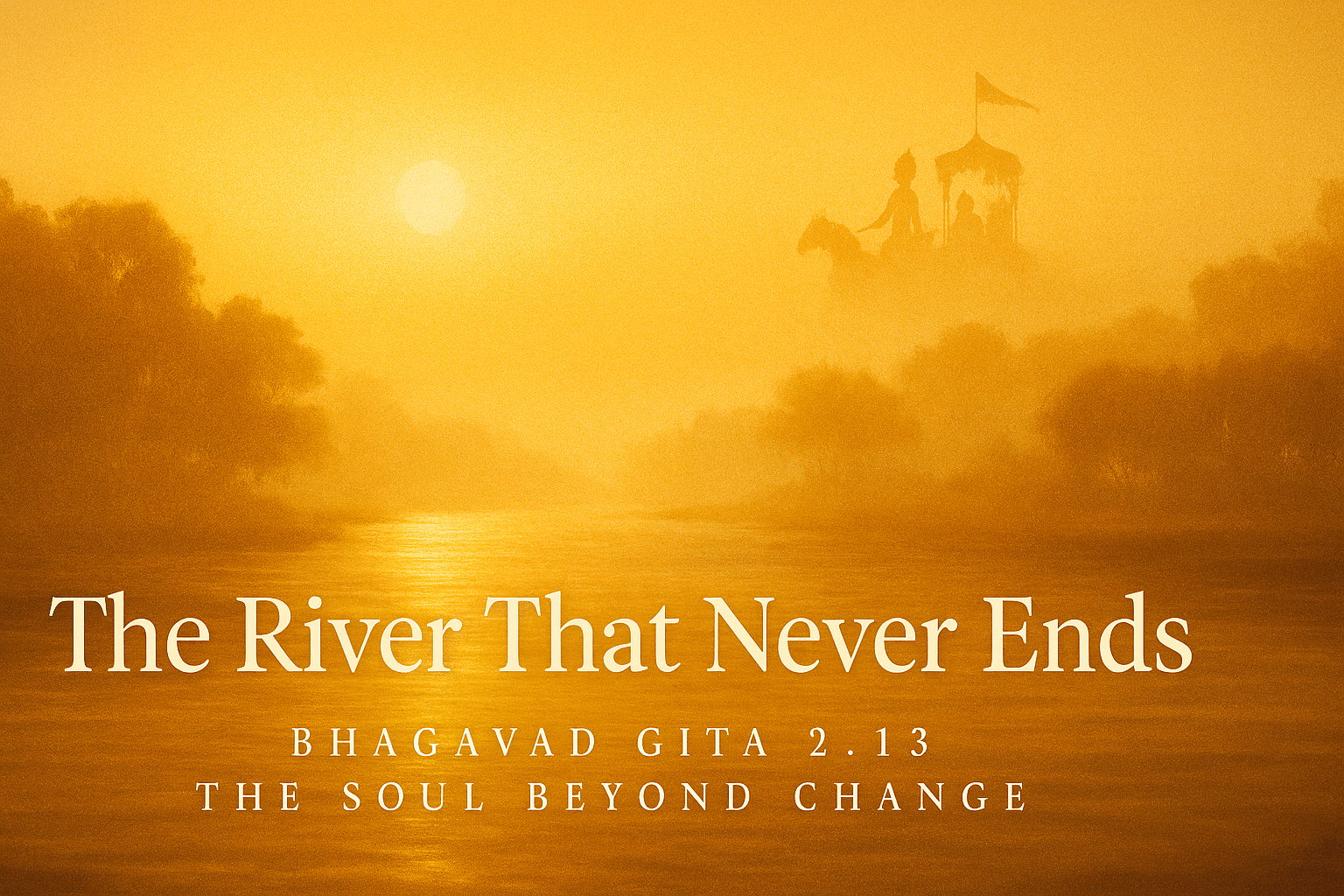
Every teaching in the Bhagavad Gita flows like a river — timeless, unbroken, and quietly alive beneath the noise of our lives. Chapter 2, Shloka 13, is not a verse about death; it is a revelation about continuity. It whispers through ages: nothing truly ends, because the essence never ceases to flow.
The Soul as a River — Flowing Through Forms
Imagine a river winding through valleys, cities, and forests. At every bend, it changes shape, yet the water — the essence — remains the same. The body, like the riverbank, shifts with time. Childhood, youth, and old age are merely turns of the current. The soul, like the river’s water, keeps moving — carrying memory, learning, and quiet resilience.
Krishna’s message in Gita 2.13 echoes this truth: our identities change, but our consciousness — the eternal observer — continues without pause. The wise recognize this continuity not as theory, but as peace itself.
We Fear Endings Only When We Forget We Are Eternal
Every sorrow in life begins with forgetfulness — not of events, but of essence. We mistake the transient for the permanent, and the permanent for an idea. But Krishna reminds Arjuna, and all of us: the end of a chapter is not the end of the story. The river doesn’t stop at the shore; it merges with the sea.
When we see change through this lens, even pain becomes sacred. Loss becomes renewal. Separation becomes transformation. The cycle of life stops being a circle of fear and becomes a spiral of growth.
You can explore this insight further in Gita Wisdom for Daily Life, which dives into applying timeless Gita lessons to modern challenges.
The Changeless Witness Within
Beneath the shifting emotions, roles, and names lies the silent witness — untouched, unwavering, and infinite. When you sit quietly and observe your breath, your thoughts, your sensations — there’s something that watches all of it unfold. That watcher never grows old. That is the Atman — your true self, eternal and luminous.
Meditation isn’t an escape from life; it’s a way of touching that stillness again. When you remember that you are not the changing body, but the awareness that perceives it, every fear of loss softens.
This realization forms the heart of the Spiritual Essence of Life — the eternal thread that runs through every breath, every moment, every being.
The Mantra for Reflection
“I am not the child I was, nor the elder I will be — I am the flow between.”
This line captures the soul’s journey through existence. You are not fixed in any form, label, or moment. You are the flow itself — learning, shedding, expanding. The next time fear visits, whisper this mantra to yourself. Let it remind you that endings are simply pauses in the song of being.
A Closing Reflection — Living the Eternal Within
As the digital and physical worlds accelerate, remembering this truth becomes an act of quiet rebellion. The river of consciousness still runs through every scroll, conversation, and silence. It waits for you to stop identifying with the waves and remember — you are the water.
The Bhagavad Gita doesn’t end in surrender; it ends in awakening. Krishna’s words remind us that life’s motion doesn’t diminish the soul’s stillness — it reveals it.