
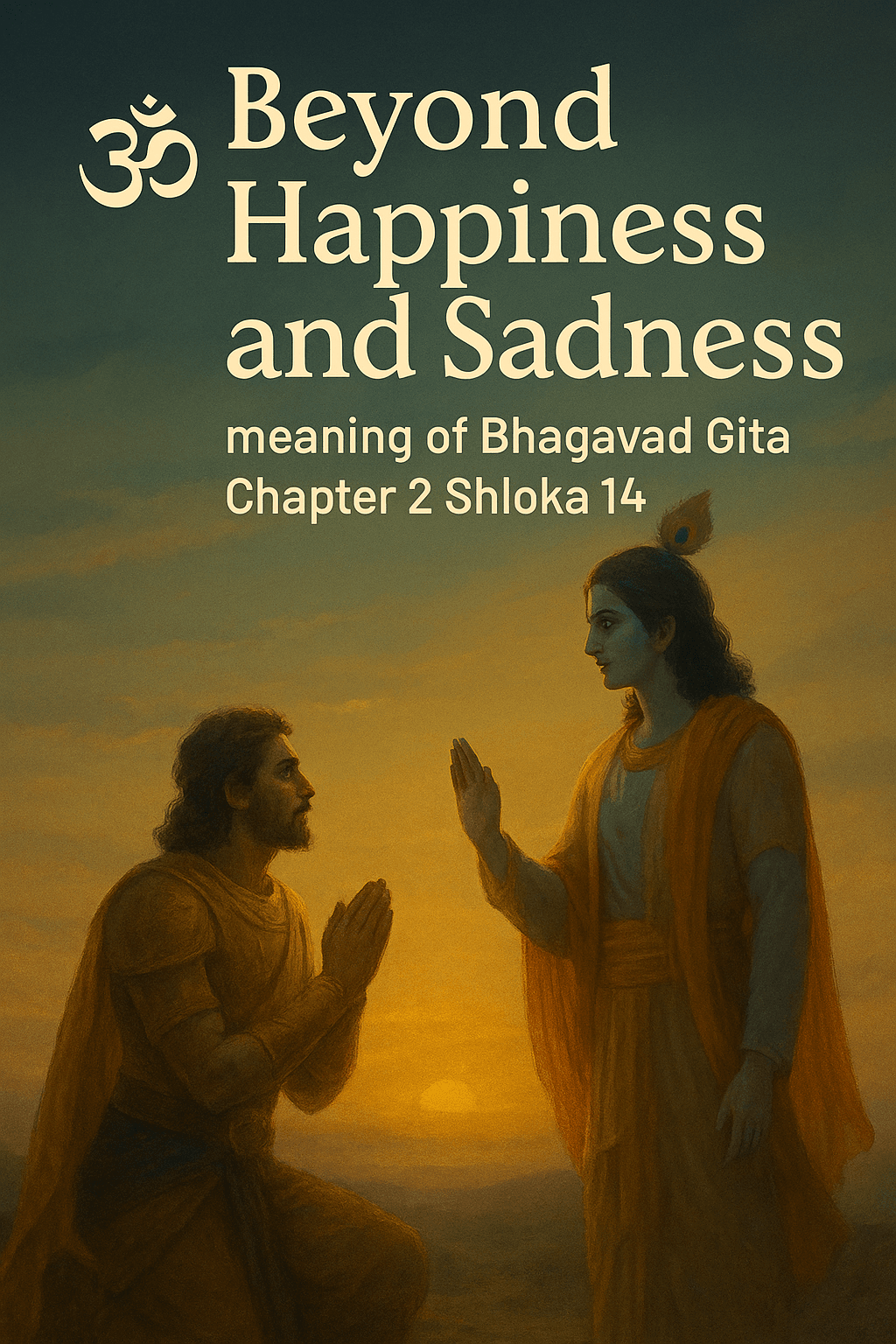
Bhagavad Gita Chapter 2 Shloka 14 Meaning reveals Lord Krishna’s timeless guidance on how to face life’s dualities — pleasure and pain — with awareness and balance.
1️⃣ Opening Scene — The Moment of Human Fragility
The day begins quietly — a faint golden light enters the room, a cup of tea steams beside the bed, and a phone screen flickers alive. The thumb moves automatically, scrolling through headlines, notifications, and faces that blur together. Some bring joy, others sorrow. Yet beneath them all lies a quiet exhaustion — the fatigue that comes not from labor, but from living too much on the surface of life.
In that moment, something deeper stirs — a whisper, a question: “Why does joy fade so quickly, and why does pain feel endless?” This subtle ache of modern life — the restlessness between pleasure and pain — is not new. Thousands of years ago, Arjuna stood trembling on the battlefield of Kurukshetra, caught in a similar storm of emotion. His bow slipped from his hands, not from fear of death, but from the unbearable weight of feeling — of love, duty, and loss colliding at once.
We may not hold a bow, but we hold our devices with the same trembling fingers — unsure what we are fighting for. Our battlefields are digital, emotional, invisible; yet the confusion is timeless. The question that haunted Arjuna still haunts us: “How do I act when my heart is torn?”
When Lord Krishna began to speak, his first words were not commands but compassion. He reminded Arjuna — and through him, all of us — that true clarity begins not with reaction, but with reflection. In a world where constant noise has replaced silence, this message feels even more urgent today.
To understand how Krishna begins this profound dialogue, read
Bhagavad Gita Chapter 2, Shloka 11 — The Beginning of Wisdom.
It is there that Krishna first plants the seed of self-understanding — the wisdom that grows only in moments of stillness.
Reflection: Perhaps the true battlefield is not outside us, but within — in the quiet struggle to stay aware amidst endless distractions.
The Shloka Itself — Sound and Silence
मात्रास्पर्शास्तु कौन्तेय शीतोष्णसुखदुःखदाः।
आगमापायिनोऽनित्यास्तांस्तितिक्षस्व भारत॥
Transliteration: Mātrā-sparśās tu kaunteya śītoṣṇa-sukha-duḥkha-dāḥ
Āgamāpāyino’nityās tāṁs titikṣasva bhārata
Translation: “O son of Kunti, the contact between the senses and their objects gives rise to cold and heat, pleasure and pain. These experiences come and go; they are impermanent. Therefore, O Bharata, endure them with patience.”
When one reads the words “Mātrā-sparśās tu Kaunteya…” aloud, there’s a rhythm — a rise and fall like breath itself. The sound flows with calm assurance, almost like a cool breeze touching the skin after an exhausting day. It doesn’t command; it comforts. Yet within that softness lies an unshakable strength. This is not the voice of rebuke, but of awakening — Krishna’s gentle firmness that embraces both compassion and clarity.
Notice how the verse begins not with abstraction but sensation — the meeting of senses and the world. Krishna doesn’t deny human experience; he dignifies it. He tells Arjuna, and us, that pleasure and pain are not enemies — they are visitors. They come with the morning and fade with the dusk. What remains constant is the one who witnesses them — the awareness behind every experience.
In a way, this shloka is less an instruction and more an invitation — to stand still when life pulls us apart. To realize that even in discomfort, something deeper is steady and untouched.
If you wish to see how this wisdom builds on earlier verses, explore
Bhagavad Gita Chapter 2 Shloka 12 — The Secret of the Eternal Self.
Together, these verses form a bridge — from understanding life’s impermanence to realizing one’s inner permanence.
Reflection: Perhaps the real power of this verse lies not in its words, but in its silence — the pause it creates inside us when we realize that every feeling, too, will pass.
Context — When Krishna Speaks of Endurance
Imagine Kurukshetra once again — the wind carrying the dust of countless chariots, the trembling of earth beneath restless horses, and the silence that follows the sound of a single warrior’s breath. Arjuna stands still, his bow lowered, eyes clouded not by battle smoke but by moral confusion. The field that was meant for war has turned into a stage of inner collapse.
It is in this fragile silence that Lord Krishna begins to speak. His words do not rush to command; they arrive like rain after heat — calm, cleansing, and precise. Before asking Arjuna to rise, Krishna does something deeply human — he acknowledges his pain. He names it. He teaches Arjuna not how to fight, but how to feel without breaking.
This is the essence of Bhagavad Gita Chapter 2, Shloka 14 — the lesson of endurance before duty. It stands as a bridge between two revelations. In Gita 2.11, Krishna begins by challenging grief — telling Arjuna that the wise do not lament. Then, in
Gita 2.12 — The Soul’s Journey, he unfolds the mystery of immortality — that the self neither dies nor is born. And now, with 2.14, he shows how to live with that truth in a world that constantly tests it.
The battlefield of Kurukshetra, thus, becomes a metaphor for every moment when life demands courage — not to conquer others, but to remain centered when everything wavers. Krishna’s teaching is not stoicism; it’s spiritual tenderness. To feel fully, yet not drown in feeling — that is the path of balance, the root of all endurance.
Reflection: True strength is not the absence of emotion but the ability to hold it gently — like Arjuna, learning to breathe again amid the dust and echoes of life’s battlefield.
The Meaning — Why Pain and Pleasure Are Teachers, Not Enemies
Krishna’s choice of words — “शीतोष्ण सुखदुःखदाः” — is profound. In just a few syllables, he captures the entire rhythm of life. Heat and cold, pleasure and pain — these are not opposites, but the two breaths of existence. One inhales, the other exhales. To deny either is to stop breathing altogether.
In our lives, we often label experiences as “good” or “bad,” as if the universe were divided by comfort. A heartbreak feels like an ending, while sudden praise inflates our sense of self. But both moments, when observed closely, carry the same lesson — impermanence. What burns today will cool tomorrow, and what soothes today will fade tomorrow. Nothing stays. And that’s where the wisdom lies.
Modern psychology calls this balance “emotional regulation.” The ability to hold both joy and grief without losing one’s center. As one therapist once described, “Emotional regulation is the new tapasya.” We are not meant to suppress emotion but to witness it without collapsing. Krishna, centuries earlier, had already articulated this — when he asked Arjuna to endure, not escape.
In real life, this plays out in the smallest ways: a rejection email that ruins the day, a compliment that inflates the ego, a friend’s silence that feels like betrayal. But when we pause, when we see the emotion as passing weather rather than identity, something shifts. The heart expands. We begin to grow beyond the experience rather than shrinking within it.
For Krishna, this awareness is not philosophy — it is preparation for courage. Before we face the world, we must first face ourselves. As he reminds in
Bhagavad Gita 2.37 – Courage and Perspective, even victory and loss are just mirrors; what truly matters is our steadiness in the reflection.
Reflection: Pain and pleasure are not enemies; they are teachers in disguise — reminding us that the self remains whole even as the seasons of experience change.
Personal Reflection — A Winter Evening in the Mind
Once, on a quiet winter evening, I sat by my window after losing something I held dear. It wasn’t dramatic — no loud goodbyes, no thunderous heartbreak — just a quiet ache that refused to leave. That night, I opened the Bhagavad Gita and my eyes landed on the words:
“मात्रास्पर्शास्तु कौन्तेय शीतोष्णसुखदुःखदाः।”
It was as if the verse whispered through the cold air: “This too will pass.”
It’s strange how pain feels endless when it arrives, yet years later, it softens into something else — a kind of wisdom, maybe even tenderness. Back then, I thought endurance meant silence, but Krishna’s words taught me something subtler — it means awareness. To watch the storm without identifying with it. To let grief move through you like winter wind — sharp but cleansing.
Many readers will recognize this rhythm — the “winter evenings” of their own minds. The heartbreaks that turned them quieter, the rejections that forced self-discovery, the moments of criticism that became mirrors. What Krishna calls “Titiksha” — patient awareness — is not denial; it’s depth. It’s learning to stay with discomfort long enough for it to teach you something.
In today’s restless age, we scroll to escape pain — but what if the pain itself was an invitation? The Gita, especially
Chapter 2, Shloka 14,
reminds us that resilience isn’t built in comfort; it’s shaped in those quiet, unseen moments of endurance.
Reflection: Every heartbreak, every loss, every pause — all are teachers. With time, memory fades, but wisdom deepens. And maybe, that’s how healing truly begins — not by forgetting the pain, but by understanding what it was trying to show.
Cultural Echoes — Indian Philosophy on Sahana (Endurance)
In Indian thought, endurance — or “Sahana” — is not resignation. It is strength expressed through stillness. The Yoga Sutra (2.48) captures it perfectly:
“Tato dvandvānabhighātaḥ” — “Then one becomes unshaken by the dualities of life.”
It is the same essence that Lord Krishna conveys in Bhagavad Gita for Inner Peace: to stand rooted even when the world oscillates between gain and loss, heat and cold, joy and sorrow.
This spirit of sahana has echoed through Indian culture for millennia. Take Nachiketa, the boy who stood fearlessly before Yama, waiting days without food or fear to learn the truth of death. Or King Harishchandra, who lost his kingdom, family, and dignity but refused to abandon truth. Or Meerabai, who sang her devotion even while poisoned by those she loved. These stories are not about suffering — they are about stillness in suffering. About choosing clarity when chaos tempts despair.
Perhaps that’s why the Indian psyche carries such natural acceptance of duality. The same farmer who prays for rain in June also prepares for drought in September. The same person who lights a lamp for Diwali knows monsoon darkness by heart. We are, in a way, trained by seasons to live with opposites. Sahana is not something learned — it is remembered, lived, inherited.
Modern life, however, often confuses endurance with passivity. But the true meaning, as Krishna teaches, is conscious engagement without collapse. To feel the heat and the cold and still keep walking. To face pleasure and pain and still remain present. That is sahana — the quiet revolution within.
Reflection: The one who endures does not escape life — they embrace it entirely, without demanding it to be perfect.
Modern Parallel — The Digital Sukha-Duhkha Cycle
When Krishna spoke of “मात्रास्पर्शास्तु कौन्तेय” — sensory contacts that give rise to pleasure and pain — he was describing a truth that has only grown more relevant in our digital age. Today, the battlefield is not Kurukshetra; it’s the glowing rectangle in our hands. Every vibration, every notification, every ping is a modern मात्रास्पर्श — a fleeting touch of excitement that promises joy but often leaves behind fatigue, comparison, and restlessness.
Psychologists now call it the “dopamine loop.” You check your phone for a message — there’s none. You refresh again — a new like, a new view, a momentary rush. For a second, it feels like connection, validation, even meaning. But moments later, the silence returns, deeper than before. We are addicted not to pleasure, but to the anticipation of it — to the endless cycle of digital sukha-duhkha that Krishna warned about centuries ago.
This pattern mirrors the verse’s essence — the highs and lows born from sensory contact. The more we identify with them, the more we drift from our inner stillness. In our era, practicing titiksha means noticing this loop and stepping back from it, reclaiming the quiet within. The pause between two notifications can become the space where awareness begins to grow.
I explored this deeper in my
Digital Awareness and Self-Reflection Story,
where mindfulness becomes the modern tapasya — not to reject technology, but to rise above its grip. Krishna’s teaching invites us to do the same: to use contact without being consumed by it, to experience without attachment.
Reflection: The true test of awareness today is not silence in isolation, but peace in a world that never stops buzzing.
Emotional Depth — What Endurance Really Means
When Krishna says, “तितिक्षस्व भारत” — “O Bharata, endure,” he is not asking Arjuna to suppress emotion. He is inviting him to understand it. Endurance, in its purest form, is not numbness but clarity — the quiet courage to stand firm when life changes its rhythm. Titiksha is not about being unfeeling; it’s about feeling deeply and yet not being carried away.
There is a fine line between tolerance and transcendence. Tolerance endures pain by gritting the teeth, waiting for it to pass. Transcendence, however, transforms pain into awareness. One suffers consciously, learns from it, and grows lighter. Krishna’s teaching is not stoic indifference — it is emotional intelligence in its highest form, centuries before psychology gave it a name.
I once met a farmer in rural Madhya Pradesh who had lost his crops to floods three years in a row. When I asked how he managed to stay calm, he smiled and said, “The soil doesn’t complain when it’s dry or wet — it just receives. I’m learning that.” His words echoed this verse more powerfully than any scripture. Endurance was not his weakness; it was his quiet strength. Similarly, a mother waiting outside a hospital ward or a student failing an exam — their resilience carries the same timeless energy of titiksha.
In a world obsessed with instant results, Bhagavad Gita Chapter 2, Shloka 14 reminds us that strength isn’t loud — it’s patient.
As Krishna teaches in 2.47, the right action lies in effort, not outcome. Endurance is that space between the two — where grace silently resides.
Reflection: True endurance is not surviving storms, but learning to dance with the rain without fear of getting wet.
Psychological Angle — Pain as Neural Memory and Spiritual Lesson
Modern neuroscience, surprisingly, walks hand in hand with Krishna’s wisdom from Bhagavad Gita Chapter 2 Shloka 14. When Krishna says, “These sensations of heat and cold, pleasure and pain, come and go — endure them,” he is describing what psychology now calls neural conditioning. Every experience leaves a trace in the brain — a pattern of electrical and chemical memory. When a similar situation returns, the mind automatically reacts, often before we even realize it.
This is where the teaching of non-reaction becomes revolutionary. Neuroscientists explain that mindfulness — the practice of observing without judging — literally rewires the brain’s response system. When we stop identifying every discomfort as pain or every praise as happiness, our amygdala (the brain’s fear and emotion center) begins to quiet down. The prefrontal cortex, which governs clarity and reason, strengthens. Krishna’s “titiksha” was thus not mere moral advice — it was cognitive mastery centuries ahead of modern psychology.
Stress, anger, and anxiety are nothing but the body’s way of remembering old pain. Mindfulness allows us to witness those memories without drowning in them. Endurance in the Gita’s sense is not denial — it’s awareness that experiences are “āgamāpāyinaḥ anityāḥ” — they come and go. Pain becomes a message, not an identity.
In my
Digital Age Focus Article – Mind Training,
I explore how this understanding transforms stress into strength. By combining mindfulness with Krishna’s teaching, we turn neural reactions into conscious choice — the essence of spiritual growth in the modern world.
Reflection: The brain learns from repetition; the soul evolves through awareness. Endurance bridges the two.
Societal Mirror — Endurance in a Time of Instant Gratification
We live in an age where everything is one tap away — food, validation, entertainment, even distraction. The world has never been faster, yet never more fragile. In contrast, Bhagavad Gita Chapter 2 Shloka 14 whispers a timeless truth: “O son of Kunti, endure the sensations of heat and cold, pleasure and pain; they come and go.” The discipline Krishna spoke of has slowly eroded under the weight of convenience. What was once earned through patience is now expected instantly.
Modern society celebrates comfort as progress, but too much comfort breeds fragility. When every inconvenience feels unbearable, even a minor discomfort can spiral into despair. The very muscles of resilience — once built through delay, duty, and discipline — have weakened in the constant pursuit of ease. Krishna’s call for titiksha is not a rejection of modernity, but a reminder that without endurance, strength remains superficial.
Consider a teenager today, overwhelmed by the pressure of exams or the silent judgment of social media. A single failure, a negative comment, can feel catastrophic. But those who endure — who face failure, breathe through it, and rise again — embody the living spirit of the Gita. Without titiksha, resilience remains half-born; endurance is what transforms pain into purpose.
We see the same lesson reflected in everyday struggles — from farmers facing droughts to young professionals lost in burnout. Endurance is no longer a virtue of saints; it’s a necessity for survival.
For more reflections on adapting ancient wisdom in modern life, read
Digital Awareness and Focus in the Modern World.
Reflection: The ease we chase outside often takes away the strength we need within. True evolution lies not in escaping discomfort, but in learning to stay awake through it.
1 The Bridge to Karma Yoga
Every teaching in the Bhagavad Gita flows into the next like a river finding its course. When Krishna speaks of titiksha — endurance — in Bhagavad Gita Chapter 2 Shloka 14, he is not merely urging Arjuna to tolerate pain. He is preparing him for Karma Yoga — the yoga of action without attachment — which culminates in Shloka 2.47. The bridge between endurance and action is inner stability. Without emotional steadiness, right action becomes impossible.
Krishna’s logic is simple yet profound: only one who can bear the fluctuations of emotion can act without fear. If pleasure excites and pain paralyzes, how can one stay true to dharma? This is why 2.14 precedes 2.47 — endurance is the soil; action is the fruit. The mind that has learned to observe sensations without drowning in them becomes fearless in the face of results. It acts with clarity, not compulsion.
In modern life, this connection remains strikingly relevant. A surgeon performing a critical operation, an artist facing rejection, or an activist working amid opposition — all rely on this same Gita wisdom. Their mastery lies not in control over the world but in balance within themselves. Tolerance, then, becomes not a passive endurance but the active strength that sustains purpose through uncertainty.
Krishna’s teaching reminds us that spirituality is not withdrawal from life but a refined way of living it. Endurance trains us for equanimity; equanimity enables selfless action — the very essence of Karma Yoga. And it all begins with the quiet courage to stay still when everything around demands reaction.
Reflection: The one who has mastered patience has already taken the first step toward perfect action — for action without peace is just motion, not purpose.
Writer’s Inner Monologue — What Krishna Told Me in Silence
It was a quiet evening — the kind where even the air seems to pause. The world outside hummed with notifications, deadlines, and passing noise, but inside me there was a heaviness that words couldn’t explain. I remember sitting by the window, watching the faint trail of a sunset fade into dusk, and asking silently — “Why do I feel so tired, even when nothing is wrong?”
And in that silence, it felt as if someone was standing beside me — calm, unwavering, patient. Not speaking, yet saying everything. That was when I remembered Bhagavad Gita Chapter 2 Shloka 14: “मात्रास्पर्शास्तु कौन्तेय शीतोष्णसुखदुःखदाः” — sensations come and go; endure them. It wasn’t a divine voice; it was a realization — that every rise and fall in emotion was simply a wave on the surface of a much deeper ocean within me.
I imagined Krishna not as a god on a chariot, but as a quiet friend who understood exhaustion — who didn’t judge the confusion, but stood beside it. “You don’t have to escape your emotions,” the silence seemed to say, “you just have to stop mistaking them for yourself.” That night, I didn’t seek answers — I sought stillness. And in that stillness, I felt a truth unfold: peace is not found by controlling life, but by letting it flow without resistance.
Perhaps that’s what Krishna told Arjuna — and all of us. To keep acting, to keep feeling, but not to drown in either. The Gita’s wisdom is not ancient — it’s alive every time we pause and listen to what the silence inside us is trying to say.
For deeper meditative reflections inspired by this realization, explore
Bhagavad Gita 2.12 – The Soul’s Journey.
Reflection: Sometimes the greatest conversation with Krishna happens in the moments when you stop trying to speak — and start learning to listen.
Lessons for Daily Life — Living Gita 2.14 Every Day
The beauty of Bhagavad Gita Chapter 2 Shloka 14 is that it is not meant for sages alone — it’s a guide for the ordinary, restless human being navigating daily emotions. Krishna’s teaching is not abstract philosophy; it’s a manual for living in balance amidst life’s noise and unpredictability. The verse reminds us that pain and pleasure, gain and loss, heat and cold — all are waves passing through the same ocean of consciousness. The key is not to resist them, but to remain aware while they pass.
In practical life, this means simple but transformative shifts:
- When anger rises — pause before reacting. Remember, it’s a wave that will fade. That space of awareness is your freedom.
- When joy inflates the ego — stay grounded. Celebrate, but don’t let it define you. Joy, too, changes form like clouds in the wind.
- When good or bad news arrives — practice stillness. Let the emotion pass through you before responding. The pause becomes a sacred act of wisdom.
- When discomfort comes — turn it into gratitude. Say to yourself, “This, too, is teaching me something.” That gratitude shifts suffering into strength.
These practices may sound simple, but they are deeply spiritual. They transform reaction into response — the essence of mindfulness. As Krishna reminds us, self-mastery begins with observation, not control. Through small acts of awareness, life begins to soften; we learn to see not just what happens, but how we meet it.
For deeper reflections on how the Gita can help you handle daily stress and inner conflict, read
Bhagavad Gita for Stress and Peace.
Reflection: Every emotion is a messenger — the question is, will we shout at it, or listen to what it’s trying to teach?
Symbolism — Seasons as Metaphor of Mind
In Bhagavad Gita Chapter 2 Shloka 14, Krishna uses the imagery of “शीतोष्ण” — cold and heat — not just as physical experiences, but as profound metaphors for the human mind. Just as seasons change, the inner climate of our consciousness shifts from calm to storm, from serenity to restlessness. This verse, simple in sound yet deep in essence, is a reminder that inner weather is temporary — and awareness is the eternal sky that holds it all.
Think of a winter morning — still, pale, silent. The air is cold, but the calm has its own kind of peace. Now imagine a scorching summer afternoon — bright, loud, almost unbearable. Our emotions mirror these natural rhythms: moments of detachment like winter, moments of passion like summer. Yet both are part of the same Earth, just as all emotions belong to the same consciousness.
Krishna’s wisdom invites us not to resist these shifts but to witness them without judgment. “Let the heat come, let the cold pass,” he seems to say — “you are neither.” The mind, like nature, has cycles; awareness is the unchanging witness to them all.
Try this short meditative exercise:
- Sit quietly for two minutes. Observe your breath as if it were the wind of your inner world.
- When a thought arises, ask — is it winter or summer? Calm or restless?
- Instead of reacting, just name it and let it pass — like watching clouds drift across the sky.
This simple awareness practice reflects the heart of titiksha — the art of staying steady amidst change.
For further exploration on cultivating balance through awareness, visit
Digital Awareness & Focus in Modern Mindfulness.
Reflection: Seasons will always come and go — wisdom is learning to stand like the tree, rooted, patient, and awake.
The Turning Point — From Resistance to Acceptance
There is a profound stillness that follows the storm of Arjuna’s despair on the battlefield of Kurukshetra. When Krishna speaks in Bhagavad Gita Chapter 2 Shloka 14, he does not give Arjuna new weapons — he gives him new vision. Arjuna, who once trembled at the thought of fighting his own kin, begins to realize that true courage is not the absence of emotion but the mastery of response. The teaching of “तितिक्षस्व भारत” — “Endure, O Bharata” — becomes the seed of that transformation.
Krishna’s words mark the turning point in Arjuna’s journey — from resistance to acceptance, from paralysis to participation. By learning that pain and pleasure are transient, Arjuna begins to see life as a sacred flow rather than a fixed struggle. The clarity that follows is not born of control, but of surrender — not to fate, but to understanding. Acceptance, as Krishna teaches, is not passive submission; it is alignment with truth.
In modern terms, this is the same wisdom echoed in self-help and psychology: what you resist, persists; what you accept, transforms. Whether it’s anxiety, loss, or failure, healing begins when we stop fighting reality and start listening to what it’s showing us. Acceptance does not make us weak; it makes us free. It allows us to act without inner conflict — to live from clarity instead of compulsion.
For those seeking to translate this spiritual shift into personal development, explore
Bhagavad Gita for Personal Growth — a reflection on how Gita’s timeless wisdom reshapes modern life.
Reflection: The day we stop asking “Why me?” and start asking “What is this teaching me?” — that is the moment our own Kurukshetra becomes our awakening.
Comparative Insights — Stoicism, Zen, and the Gita
Though Bhagavad Gita Chapter 2 Shloka 14 was spoken on the banks of the ancient Saraswati, its resonance travels through civilizations. Across time and geography, the same wisdom reappears — in Stoic philosophy, in Zen practice, in Sufi silence. Each path, in its own language, whispers one truth: peace is not found in controlling life’s storms, but in mastering our response to them.
When Epictetus said, “It’s not what happens to you, but how you react to it that matters,” he was, unknowingly, echoing Krishna’s “तितिक्षस्व भारत.” Marcus Aurelius, the philosopher-king, wrote in his Meditations, “Choose not to be harmed — and you won’t feel harmed.” The Stoics called this tranquility, a steadiness that does not depend on circumstance. In the Gita, Krishna calls it समत्व — equanimity, the balanced state where one neither clings to pleasure nor collapses in pain.
Similarly, Zen masters describe this awareness as the “still pond” of the mind — when the ripples of thought and desire settle, reflection becomes clear. A Zen koan says, “The wild geese do not intend to cast their reflection — the water has no mind to receive it.” This mirrors the Gita’s essence: experience flows, but awareness remains untouched.
These teachings, though born in different worlds, converge on the same still center. Whether one calls it Atman, Logos, or Zen mind, the destination is inner steadiness — a state where the self no longer reacts, but witnesses. This is not withdrawal, but supreme participation — being fully present without losing inner balance.
For readers interested in exploring how these philosophies meet, read
Bhagavad Gita for Inner Peace.
Reflection: The Stoic calls it tranquility, the Yogi calls it Samatva — but the wise call it home.
Story Interlude — A Train Journey or Temple Visit
It was during a quiet evening train ride from Varanasi to Delhi that the meaning of Bhagavad Gita Chapter 2 Shloka 14 suddenly came alive. The sun dipped low beyond the horizon, spilling molten gold over the tracks. Inside the compartment, life unfolded in miniature — a child laughed over a packet of chips, an old man murmured a prayer, a young woman scrolled endlessly on her phone. The same sunset — yet a different world for each of them. Krishna’s words echoed softly within: “The senses meet their objects, O Arjuna, and bring heat and cold, pleasure and pain. They come and go — endure them.”
As the rhythmic clatter of the train filled the space, I realized how transient everything was — the stations, the faces, even the thoughts passing through my own mind. For one passenger, the train was a routine commute; for another, a pilgrimage. What we call “experience” is simply how we color the same reality with the palette of our perception. Our reactions are not truths — they are choices.
Later that week, while sitting in a small temple courtyard, I heard the evening aarti rise and fade with the same rhythm as that train’s wheels. The sound of bells and chants came like waves — arising, subsiding, arising again. And in that ebb and flow, I saw the essence of Krishna’s teaching: life doesn’t stand still; it moves, dissolves, and renews. To resist is to suffer. To witness is to awaken.
For readers who wish to explore more reflections on living with awareness amidst constant change, visit
Digital Awareness & Focus in Modern Mindfulness.
Reflection: The sunset, the chant, the passing faces — all are reminders of the same truth: everything changes, yet the one who sees remains unchanged.
Inner Science — How Suffering Polishes Awareness
There is a line in the Gita that quietly transforms pain into wisdom — “मात्रास्पर्शास्तु कौन्तेय शीतोष्णसुखदुःखदाः.” When Krishna says this, he is not asking us to ignore suffering; he is asking us to understand it. Pain, in this light, is not punishment — it is polishing. Just as fire purifies gold, suffering refines consciousness. It burns away illusions and leaves behind something more luminous — awareness itself.
In modern language, neuroscience calls this process neuroplasticity — the brain’s ability to rewire itself through experience. What Krishna called “तितिक्षा” or endurance, science calls adaptation. When we face pain consciously, without running or resisting, we create new mental pathways of strength. Every conscious breath taken in discomfort is a small rewiring — a bridge between ancient Tapasya (inner discipline) and modern cognitive transformation.
The “Tapasya of Perception” is this very act — to sit with life as it is, to let experience reveal its texture instead of labeling it as “good” or “bad.” The mind learns not through comfort, but through contact with challenge. Each tear, each loss, is a silent teacher reminding us that awareness expands only when it is tested. Just as the sky remains untouched by clouds, the Self remains unscarred by sorrow. The art lies in remembering that.
For deeper insights on this balance of pain and awareness, visit
Bhagavad Gita for Stress and Peace — exploring how ancient wisdom aligns with modern psychology.
Reflection: The heart breaks not to weaken us, but to let the light pass through the cracks — polishing awareness into clarity.9️⃣ Integration — From Understanding to Embodiment
The teachings of Bhagavad Gita Chapter 2 Shloka 14 are not meant to be admired from afar like a sacred text behind glass. They are meant to be lived — breathed, practiced, and slowly absorbed until they become the pulse of one’s awareness. Krishna doesn’t simply tell Arjuna to “know” endurance; He invites him to embody it. Understanding must flow into practice — and practice into presence.
Step 1: Awareness — Begin by noticing. Every time you feel joy or irritation, stop for a moment. Observe the mind’s dance — how it reaches out toward pleasure and recoils from pain. Just noticing is the first layer of awakening. Like Krishna on the chariot beside Arjuna, awareness sits quietly beside every emotional battle, whispering, “See this clearly before you act.”
Step 2: Acceptance — Once you see the movement, resist the urge to label it. Instead of fighting discomfort, breathe through it. Say softly, “This too is passing.” Pain loses its sting when we stop personalizing it. The heat and cold of life, as Krishna said, are temporary — visitors, not tenants. Acceptance is not weakness; it is inner strength that neither clings nor condemns.
Step 3: Action — From awareness and acceptance arises true action — calm, precise, and unburdened by reaction. In this space, the smallest gesture — a word of kindness, a breath of restraint — becomes karma aligned with dharma. This is where Gita’s philosophy meets real life.
Morning Ritual: Before beginning your day, pause and whisper:
“May I see both joy and sorrow as passing visitors — and remain rooted in what never leaves.”
To deepen this daily practice, read
Bhagavad Gita for Personal Growth — an inner guide to embody timeless wisdom in modern routines.
Reflection: Endurance is not about surviving storms; it’s about walking through them with open eyes and an anchored heart.
Closing Reflection — The Gift of Titiksha
There comes a moment in every seeker’s life when the mind stops asking, “Why me?” and begins to whisper, “What is this teaching me?” That moment — subtle, quiet, almost imperceptible — is the birth of Titiksha. It is not the end of suffering; it is the beginning of understanding. When Krishna tells Arjuna, “तितिक्षस्व भारत,” he isn’t commanding endurance through gritted teeth. He is offering a gift — the gift of inner freedom amidst inevitable change.
We spend so much of life running — from discomfort, from loss, from silence. Yet, as Bhagavad Gita Chapter 2 Shloka 14 reveals, freedom is not found by escaping life’s opposites but by embracing them fully. Heat and cold, joy and sorrow, praise and blame — they visit us like changing seasons. The wise do not chase summer or curse the rain; they walk through both with steady breath and open eyes.
“When you stop running from suffering, you begin to walk with Krishna.”
That is the quiet truth of Titiksha — to live as if guided by the same charioteer who once steadied Arjuna’s trembling heart. The next time you feel joy rising or pain pressing, pause. Breathe. Ask yourself: “Can I meet this moment as Krishna asked — without clinging or resistance?”
This is not resignation; it is mastery. The art of living lies not in control, but in composure. When you begin to walk with awareness, even suffering becomes sacred — a teacher disguised in discomfort.
To explore more reflections on life through the wisdom of Gita and modern mindfulness, visit
Observation Mantra — Home.
Reflection: Titiksha is the bridge between reaction and realization — the space where pain transforms into purpose, and every wound becomes a window to awareness.
Epilogue – A Quiet Challenge to the Reader
Before you close this page and move on with your day, pause for a breath. Krishna’s words in Bhagavad Gita Chapter 2 Shloka 14 are not meant to stay in theory — they are an invitation to live differently, even if for a single moment. So here’s a gentle challenge:
In the next 24 hours, can you observe one emotion — joy, irritation, excitement, fear — without naming it as good or bad?
Simply notice it. Feel its rise and fall without chasing or rejecting it. That is Titiksha in action — the quiet art of watching your inner waves without drowning in them. This one simple act can open a door to a stillness you didn’t know existed — a space between reaction and awareness.
Share your experience in the comments — what happened when you stopped labeling your feelings? Did the emotion lose its grip, or did you see something new in yourself? These reflections turn philosophy into lived experience, and conversation into collective introspection.
If you wish to continue this journey, move deeper into the next verse — Bhagavad Gita 2.15 – How Endurance Leads to Freedom.
There, Krishna takes Titiksha a step further — showing how resilience matures into liberation.
For foundational insights, revisit:
The Beginning of Wisdom (2.11),
The Soul’s Journey (2.12), and
The Essence of Karma Yoga (2.47).
For a modern reflection, explore
Digital Mindfulness – How Mobile Moments Spark Awareness
and tag articles on
Bhagavad Gita for Stress and Peace,
Inner Peace, and
Personal Growth.
Reflection: Every moment you observe without judgment, you walk beside Krishna — not as a student repeating his words, but as a seeker living them.